
General Asad Durrani's disclosures could leave considerable egg on the face of those currently wielding the stick in Pakistan, notes Rana Banerji, who headed the Pakistan desk at the Research and Analysis Wing, India's external intelligence agency.
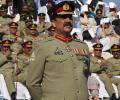
The recent postings and promotions of three-star generals in the Pakistan Army have propelled some of former chief Ashfaq Parvez Kayani's favourites to traditionally important positions
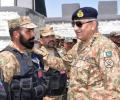
If Imran Khan delays his assent to General Bajwa's recommendations any further, it could imply he is taking stock of possible serious dissent within Pakistan's top army echelons, says Rana Banerji, who headed the Pakistan Desk at the Research and Analysis Wing, India's external intelligence agency.

With Pakistan's powerful army chief Gen Ashfaq Parvez Kayani's term coming to an end in November, names of top generals who are likely to succeed him are being discussed in the political circles and in the corridors of power.

'All Pakistan army chiefs follow a consistent line as far as India is concerned.'
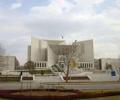
Pakistan's Supreme Court on formally charged Defence Secretary Lt Gen (retired) Asif Yasin Malik for contempt of court after he failed to deliver on an undertaking for holding local body polls in cantonments across the country.
General Bajwa remains in command as army chief and Prime Minister Imran Khan did not play any role in the reshuffle, says Rana Banerji, who headed the Pakistan Desk at the Research and Analysis Wing, India's external intelligence agency.

'Pakistan's only concern has been while they were on the FATF watch list was to distance their State institutions and organs from any direct connection with the actual execution of militancy inside Kashmir.'

Several retired and serving military officers attend Pervez Musharraf's funeral prayers.

Lt Gen Zubair Hayat appointed as Chairman of Joint Chief of Staff Committee.

Gen Sharif had earlier promised to bow out at the end of his term in November this year.
"We want good ties with all neighbours including India and Afghanistan," he told the Senators.

Barack Obama has said that he had ruled out involving Pakistan in the raid on Osama bin Laden's hideout because it was an "open secret" that certain elements inside Pakistan's military, and especially its intelligence services, maintained links to the Taliban and perhaps even al-Qaeda, sometimes using them as strategic assets against Afghanistan and India.
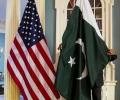
The relations between Pakistan and the US nosedived this January after US President Donald Trump accused Islamabad of giving nothing to Washington but "lies and deceit" and providing "safe haven" to terrorists.

The United States drone attack that killed Pakistani Taliban chief Hakimullah Mehsud has done "serious damage" to the Islamabad's efforts for a dialogue with militants, Prime Minister Nawaz Sharif said on Tuesday.
Pakistan National Security Advisor Sartaj Aziz brings to New Delhi a newfound Pakistani confidence, stemming from its leverage in Afghanistan, says Ajai Shukla
'Already, there is talk of a possible extension for Raheel Sharif in the context of his perceived sterling, but incomplete work in the war against terror, as also the cleansing of crime and extortion networks in Karachi,' says Rana Banerji.
'It is not difficult for a Pakistan army chief assisted by the deep state to manipulate a situation.' 'Pulwama, Uri and Pathankot, all come to mind,' cautions Lieutenant General Syed Ata Hasnain (retd).
It has been over two years since Husain Haqqani was forced to resign from the coveted post of Pakistan's envoy to the United States.

General Qamar Bajwa, his colleagues say, is a firm opponent of extremism and terrorism. He may prove even more forceful in the fight against terrorism than his predecessor, who is credited with launching Operation Zarb-i-Azb, which helped lower the frequency of terrorist attacks.
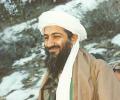
Investigative journalist Seymour Hersh claims that ISI got hold of bin Laden in 2006 after paying bribes to some of the tribal leaders

Experts trace the reasons for the 26/11 attacks to the Pakistan's military interest in three key areas: Kashmir, Afghanistan and nuclear armaments.

'A close look at the time-lines tells you that exactly as the back-channel negotiations were in their most crucial stage, "somebody" was planning the 26/11 attacks in Mumbai,' says Shekhar Gupta questioning Khurshid Mahmud Kasuri's account of a peace deal with India.
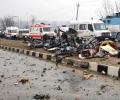
'A resurgent Jaish could be a reflection of the Pakistani security establishment's view that with the region moving ever closer to a post-US Afghanistan, it is time to redirect attention to Kashmir.'
